
How was TEMPO developed?
The TEMPO toolkit was developed to provide people with an evidence-based means to understand and address procrastination.
Specifically, we designed the TEMPO to:
- Increase understanding and awareness of the causes and consequences of procrastination.
- Promote taking a more compassionate view of procrastination and how to manage it.
- Increase knowledge about how to effectively reduce procrastination using science-backed strategies.
The development of the TEMPO was achieved through a process of co-produced research involving people with lived experience of procrastination and/or ADHD, and included a combination of consultations, focus groups, and user surveys. Development started in 2024 and was supported by the Durham University Research Impact Fund (RIF). The TEMPO toolkit was designed in collaboration with the Research Retold team.
Here is an overview of the steps involved in the development of the TEMPO.
1) Initial draft of TEMPO

The initial structure and content of TEMPO was guided by Dr Sirois’ research and theory on the causes and consequences of procrastination. This included recent scientific evidence on the effectiveness of strategies aimed at improving mood regulation to reduce procrastination.
We then refined the TEMPO content and presentation in consultation with relevant stakeholders. These included Nik Kendall, who holds diplomas in Integrative Psychotherapy, Therapeutic Counselling, and Life Coaching, and Oscar Daniel, a neurodivergent student research assistant who was an undergraduate at the time of this initial draft stage.
2) Focus group consultation and feedback implementation
To identify suitable participants for the focus group, we first ran a brief screening survey by sending study notices to the Durham University student community. The goal was to identify individuals who struggled the most with procrastination, and to include equal numbers of neurotypical and neurodivergent participants.
We invited individuals who scored in the top 25% on a measure of chronic procrastination to participate in the focus group. 17 Durham University students participated in the 2-hour focus group, and 9/17 had a diagnosis of ADHD.

We asked participants about their experiences with procrastination, other resources they had tried, and what they did and didn’t want in a procrastination toolkit. We also asked them to provide specific feedback on the draft content of the TEMPO.
Feedback was generally positive with several useful suggestions. These included how to improve the wording and presentation of the content, which messages to emphasise, and the need for more interactive elements. We used this feedback to inform the second draft of the TEMPO alongside consultation with the Research Retold team, to refine the presentation of the TEMPO.
3) Beta testing of TEMPO second draft
We next tested the second draft of the TEMPO with a series of brief surveys administered to the general public before and after they had used TEMPO.
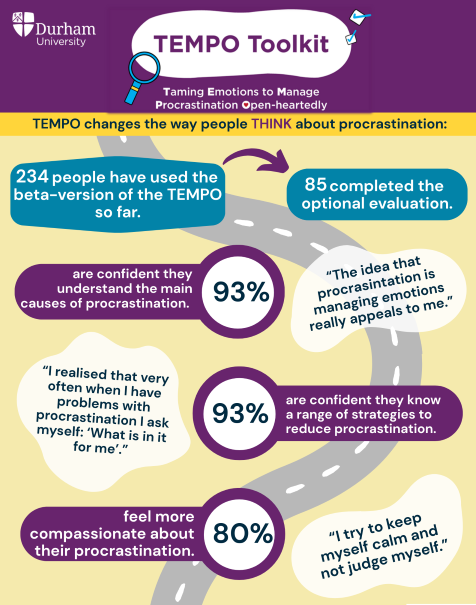
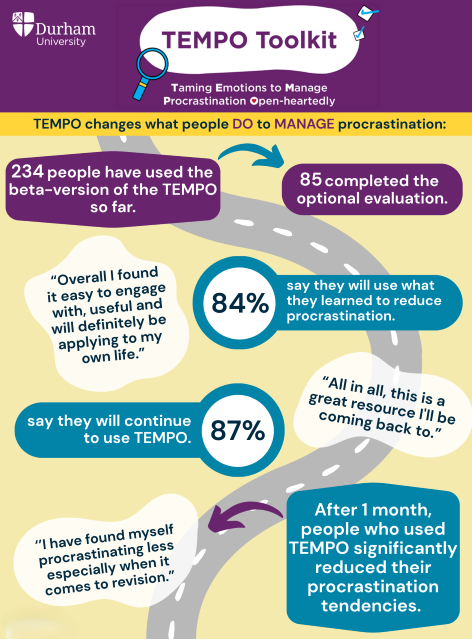
234 people completed the pre-TEMPO survey, 85 people completed the post-TEMPO survey and 36 people completed the one-month follow-up survey.
We asked questions about their understanding of procrastination and their confidence in how to address it. We also asked if they intended to use TEMPO again, and if they would use what they learned from TEMPO in the future.
We compared people’s procrastination tendencies before using TEMPO and one month later to test TEMPO’s effectiveness for reducing procrastination.
Really good resource, will definitely be using more to help me in the future. Not just to stop procrastination but to get a deeper understanding of what it is and why it happens. Thank you!!
Beta test participant
As can be seen by the testimonial above and the two infographics below, the results from the beta-testing show that people were very positive about the TEMPO. These results provided initial evidence that TEMPO increases understanding about how to effectively and compassionately address procrastination using science-backed strategies.
4) TEMPO final draft
We also received additional comments from participants in the beta testing through an open text question. These included suggestions to further refine functional aspects of the TEMPO, such as navigational and interactive elements.
Which changes to implement in the final draft of the TEMPO were decided in consultation with Fleur Riley, and Oscar Daniel.
With the launch of the TEMPO toolkit in 2026, we are gathering further evidence of people’s experiences using TEMPO, and its effectiveness for reducing procrastination over time. We will share these results as they become available.