
About

The TEMPO toolkit was created by Dr Fuschia Sirois, a Professor of Social and Health Psychology at Durham University, with input from her research associates, Fleur Riley, Oscar Daniels, and Nic Kendall, and the creative design of Research Retold.
Dr Sirois has been studying the causes and consequences of procrastination for over 25 years and has written numerous scientific and lay articles on the topic as well as a self-help book published by APA in 2022, and an audio book on Audible.
TEMPO reflects Dr Sirois desire and commitment to translate her scientific research into accessible and actionable insights for understanding and effectively addressing procrastination.
I found the toolkit looked at procrastination through a lens I’d never really considered before!
Beta testing participant
A core principle of TEMPO is that procrastination reflects difficulties with managing task-related emotions, not poor character or poor time management.
From this perspective, procrastination is best addressed from a compassionate and non-judgemental stance that acknowledges and supports people in their struggle with procrastination.

Further Reading & Resources
Here are some articles and resources from Dr Sirois on the psychology of procrastination. You can also find more resources, including podcasts, public talks, and media coverage on her web page fuschiasirois.com.
Lay Articles
Two Counterintuitive Ways to Stop Procrastinating
This is a GreaterGood.com article on why self-forgiveness and self-compassion can be effective for addressing procrastination.
Procrastinating is linked to health and career problems – but there are things you can do to stop
In this article in The Conversation Dr Sirois summarises the toll procrastination can take on health and career.
Why we procrastinate — and what you can do to break the cycle
Written for Apolitico, a resource site for civil servants, this article unpacks what procrastination is and how to manage it in your professional and personal lives.
Books
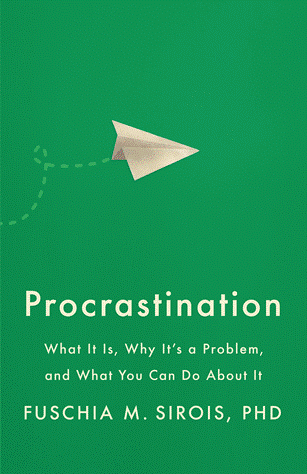
Procrastination: What it is, Why its a Problem, and What you Can do About it,
This self-help style book published in 2023 by APA presents a comprehensive, in depth and compassionate view of why people procrastinate, why procrastination is harmful, and what you can do about it. It’s packed with science-based tools for understanding and addressing procrastination in oneself and others.
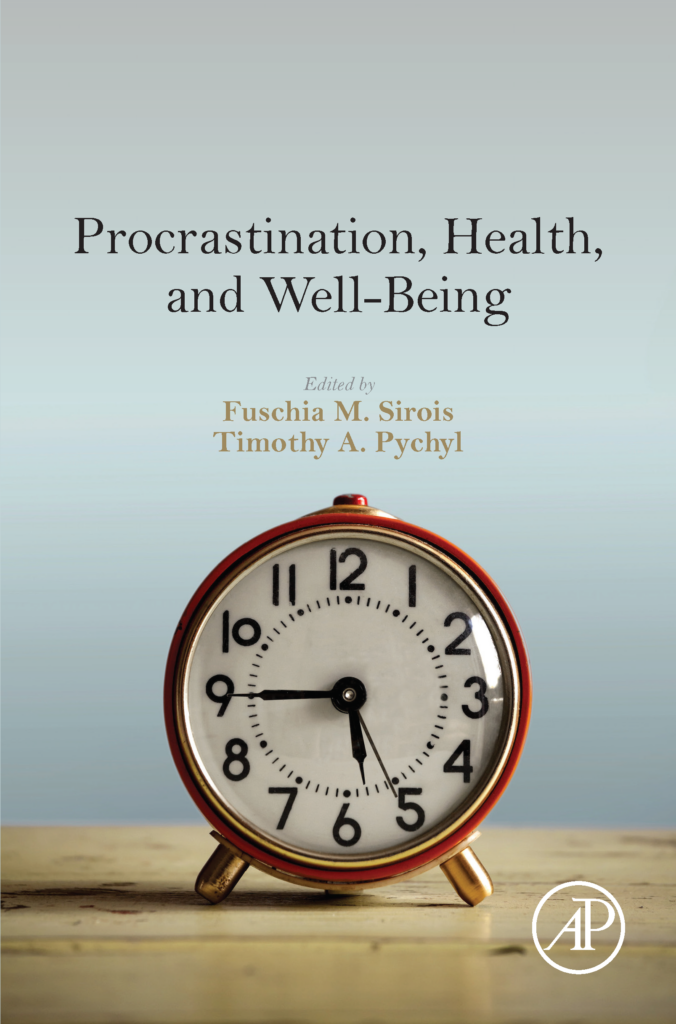
Procrastination, Health, and Well-Being
This edited volume published in 2016 with Dr Tim Pychyl includes research on the implications of procrastination for health and well-being. Written for academics and clinicians, it is the first volume to bring together cutting edge ideas and research from leading and up and coming researchers and thought leaders in the field.
Do it Now: Overcoming Procrastination
This Audible original audio book presents further insights on what procrastination is and how to overcome it. Note, this is not an audio version of the APA book but a stand alone audiobook.
Academic Journal Articles
Sirois, F. M., & Hirsch, J. K., (2026). Trait procrastination and future time orientation: Multi-sample tests of the stress orientation hypothesis. Personality and Individual Differences, 255, 113683. (IF =2.6) Open access
Chen, Z., Liu, X., Xu, T., Li, W., Zhang, R., Wu, Y., Xia, L., Lan, H., Feng, Z., Feng, T. & Sirois, F. M. (2025). Subclinical psychiatric symptomatology and a proposed diagnostic criterion separating psychopathological procrastinators from trait procrastinators. Personality and Mental Health , 19: e70022 (IF = 2.0). Link
Sirois, F. M., & Biskas, M. (2024). Procrastination and health in nurses: Investigating the roles of stress, health behaviours and social support. International Journal of Environmental Research and Public Health, 21, 898. (IF = 4.61). Open access
Rad, H. S., Samadi, S., Sirois, F. M., & Goodarzi, H. (2023). Mindfulness intervention for academic procrastination: A randomized control trial. Learning & Individual Differences, 101,102244. (IF = 3.90). Link
Sirois, F. M. (2023). Procrastination and stress: A conceptual review of why context matters. International Journal of Environmental Research and Public Health,20(6), 5031. (IF = 4.61). Open access
Sirois, F. M., Stride, C., & Pychyl, T. A. (2023). Procrastination and health: A longitudinal test of the procrastination-health model. British Journal of Health Psychology, 28, 860-875. (IF = 7.90) Open access
Sirois, F. M. (2021). Trait procrastination undermines outcome and efficacy expectancies for achieving health-related possible selves. Current Psychology, 40, 3840–3847. (IF = 2.05). Open access
Xu, T., Sirois, F. M., Zhang, L., & Feng. T. (2021). Neural basis responsible for self-control association with procrastination: right MFC and bilateral OFC functional connectivity with left dlPFCith left dlPFC. Journal of Research in Personality, 91, 104063. (IF = 3.89). Link
Sirois, F. M., *Yang, S., & van Eerde, W. (2019). Development and validation of the GPS-9, a short and reliable measure of trait procrastination. Personality and Individual Differences, 146, 26-33. (IF = 3.95). Link | Self-archived version
Sirois, F. M., Nauts, S., & Molnar D. S. (2019). Self-compassion and bedtime procrastination: An emotion regulation perspective. Mindfulness, 10, 434–445 (IF = 3.80). Link | Self-archived version
Sirois, F. M., & Giguère, B. (2018). Giving in when feeling less good: Procrastination, action control, and social temptations. British Journal of Social Psychology, 57, (2), 404-427. (IF = 6.92). Link | Self-archived version
Sirois, F. M., Molnar, D. M., & Hirsch, J. K. (2017). A meta-analytic and conceptual update on the associations between procrastination and multidimensional perfectionism. European Journal of Personality, 31, 137-159. (IF = 7.00). Link | Self-archived version
Sirois, F. M., van Eerde, W., & Argiropoulou, M. I. (2015). Is procrastination related to sleep quality? Testing an application of the procrastination-health model. Cogent Psychology, 2 (1). Open access
Sirois, F. M., & *Kitner, R. (2015). Less adaptive or more maladaptive? A meta-analytic investigation of procrastination and coping. European Journal of Personality, 29, 433-444 (IF = 7.00). Link | Self-archived version
Sirois, F. M. (2015). Is procrastination a vulnerability factor for hypertension and cardiovascular disease? Testing an extension of the procrastination-health model. Journal of Behavioral Medicine, 38, 578-589 (IF = 3.47). Link | Self-archived version
Sirois, F. M. (2014). Out of sight, out of time? A meta-analytic investigation of procrastination and time perspective. European Journal of Personality, 28, 511–520. (IF = 7.00). Link | Self-archived version
Sirois, F. M. (2014). Absorbed in the moment? An investigation of procrastination, absorption and cognitive failures. Personality and Individual Differences, 71, 30-34. (IF = 3.95). Link | Self-archived version
Sirois, F. M. (2014). Procrastination and stress: Exploring the role of self-compassion. Self and Identity, 13 (2), 128-145. (IF = 2.41). Link | Self-archived version
Sirois, F. M., & Pychyl. T. A. (2013). Procrastination and the priority of short-term mood regulation: Consequences for future self. Social and Personality Psychology Compass, 7 (2), 115–127. (IF- 3.80). Link | Self-archived version
Sirois, F. M., & *Tosti, N. (2012). Lost in the moment? An investigation of procrastination, mindfulness, and well-being. Journal of Rational-Emotive & Cognitive-Behavior Therapy, 30 (4), 237-248. (IF- 1.95). Link | Self-archived version
Sirois, F. M. (2007). “I’ll look after my health, later”: A replication and extension of the procrastination-health model with community-dwelling adults. Personality and Individual Differences, 43, 15-26. (IF = 3.95) Link | Self-archived version
Sirois, F. M. (2004). Procrastination and counterfactual thinking: Avoiding what might have been. British Journal of Social Psychology, 43, 269-286. (IF = 6.92). Link | Self-archived version
Sirois, F. M. (2004). Procrastination and intentions to perform health behaviors: The role of self-efficacy and the consideration of future consequences. Personality and Individual Differences, 37(1), 115-128. (IF = 3.95). Link | Self-archived version
Sirois, F. M., Melia-Gordon, M.L., & Pychyl, T. A., (2003). “I’ll look after my health, later”: An investigation of procrastination and health. Personality and Individual Differences, 35(5), 1167-1184. (IF = 3.95). Link | Self-archived version